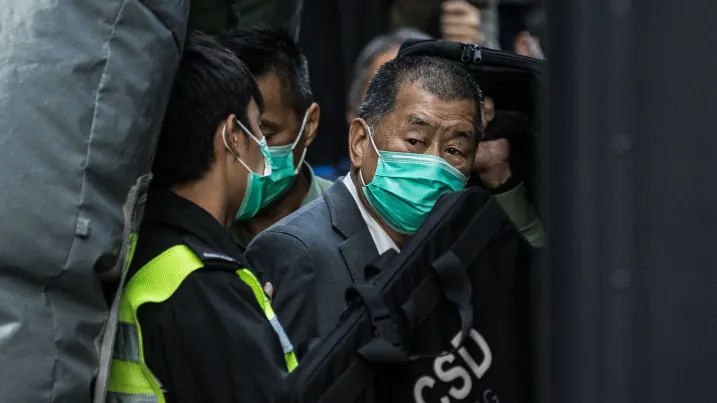
Hong Kong media baron and pro-democracy activist Jimmy Lai has been sentenced to 20 years in prison, the longest punishment imposed to date under the city’s China-imposed national security law, in a ruling that underscores the dramatic transformation of Hong Kong’s political and media environment since 2020.
In its judgment delivered Monday, Hong Kong’s High Court said: “Having stepped back and taking a global view of the total sentence for Lai’s serious and grave criminal conduct … we are satisfied that the total sentence for Lai in the present case should be 20 years’ imprisonment.”
Lai, 78, is the founder of the now-defunct Apple Daily newspaper and one of the most prominent critics of Beijing’s rule over the Chinese special administrative region. He was convicted in December of collusion with foreign forces, endangering national security, and conspiracy to publish seditious materials. He has already spent more than five years in detention and was serving a separate prison sentence related to fraud charges.
The sentence surpasses the previous record under the national security law, exceeding the 10-year prison term handed in November 2024 to activist Benny Tai, a former law professor convicted of conspiring to subvert state power.
Human rights organizations swiftly condemned the ruling. “A sentence of this magnitude is both cruel and profoundly unjust,” said Elaine Pearson, Asia director at Human Rights Watch.
Lai was among the first high-profile figures arrested in August 2020, shortly after Beijing imposed the sweeping security law in response to the massive pro-democracy protests that rocked Hong Kong the previous year. Authorities argue the law restored stability, while critics say it has been used to silence dissent and dismantle independent media.
Apple Daily ceased operations in June 2021 after police arrested senior staff members and froze the company’s assets, bringing an abrupt end to the paper’s 26-year history as one of Hong Kong’s most influential pro-democracy publications.
The case has drawn sustained international attention. U.S. President Donald Trump said in December that he had asked Chinese President Xi Jinping to consider Lai’s release, though he did not announce new measures against Beijing. British Prime Minister Keir Starmer raised Lai’s case during a visit to China last month, calling for the release of the British citizen. “Those discussions will continue, and the foreign secretary is in touch with Mr Lai’s family,” Starmer told the U.K. parliament.
Hong Kong authorities have rejected accusations that the prosecution was aimed at suppressing press freedom, arguing instead that Lai used journalism as a cover for actions that threatened national security. Prosecutors alleged that Lai conspired with six former Apple Daily employees, two activists, and others to lobby foreign governments to impose sanctions, blockades, or engage in what they described as hostile activities toward Hong Kong and China.
Lai pleaded not guilty to two charges of colluding with foreign forces under the national security law, as well as to a charge of conspiracy to publish seditious materials. His conviction and sentence are widely viewed as a defining moment in the erosion of political freedoms in a city once regarded as Asia’s leading center of press independence.