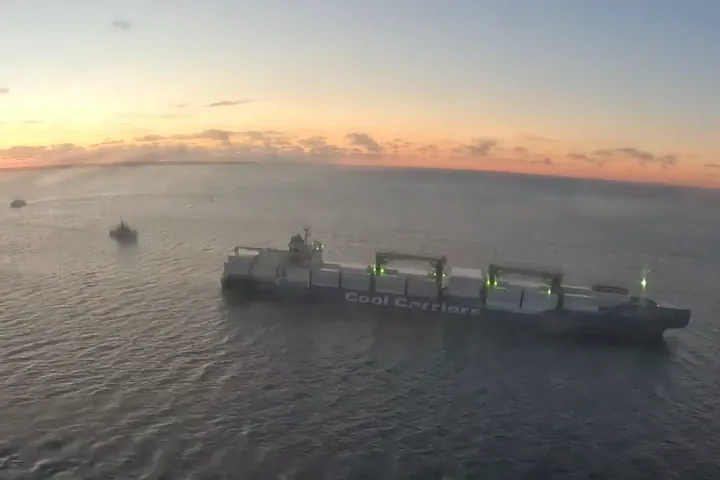
Estonian authorities have seized a Bahamas-flagged container ship bound for Russia’s St. Petersburg following what officials described as the most extensive maritime interdiction operation in the country’s history.
The vessel, Baltic Spirit, was detained in the Gulf of Finland on February 3 after entering Estonia’s territorial waters to refuel during a voyage from Ecuador to Russia, according to reporting by Estonian Public Broadcaster (ERR). The ship was intercepted and boarded by a national police special operations unit amid a coordinated, multi-agency security deployment.
Estonia’s K-Commando unit boarded the vessel and detained all 23 crew members, all of whom were identified as Russian citizens. Authorities said the operation involved approximately 50 personnel drawn from several state bodies, including the Police and Border Guard Board, the Transport Administration, the State Fleet, and the Tax and Customs Board.
Naval support was provided by Estonian Navy vessels Raju and Admiral Cowan, alongside the state fleet’s pilot boat Ahto. A Police and Border Guard rescue helicopter maintained aerial coverage throughout the boarding, underscoring the scale and complexity of the operation.
Officials emphasized that the detention was not related to sanctions enforcement. The Tax and Customs Board confirmed that Baltic Spirit is not part of Russia’s so-called “shadow fleet” and is not subject to European Union sanctions. Instead, the seizure was carried out over suspected links to smuggling activities.
Customs officials conducted an initial inspection while the ship was anchored at an officially designated Estonian anchorage. Authorities have since launched a formal investigation to determine whether the vessel was transporting illicit cargo or violated customs and maritime regulations.
Estonian officials described the operation as unprecedented, marking the first time special police forces, naval units, aviation assets, and civilian agencies were jointly deployed to seize a vessel at sea.
The seizure comes amid heightened maritime vigilance in the Gulf of Finland, a strategically sensitive corridor that has seen increased security scrutiny following recent incidents involving undersea infrastructure. Regional concern intensified after damage to the Balticconnector gas pipeline in 2023, prompting closer monitoring of vessel movements and port activity.
The operation also follows similar actions elsewhere, including the recent detention by Malaysian authorities of two oil tankers believed to be part of covert ship-to-ship transfer networks used to obscure the origin of crude oil, with cargoes valued in the hundreds of millions of dollars seized during that operation.